The problem
Families were hearing about AI in schools from the news, not from us. Teachers didn't know what was permitted, and "permission" was often communicated as a vibe. The district needed one clear, public, bilingual account of how AI is and isn't used, grounded in student-privacy law and written for people who aren't technologists.
What I built
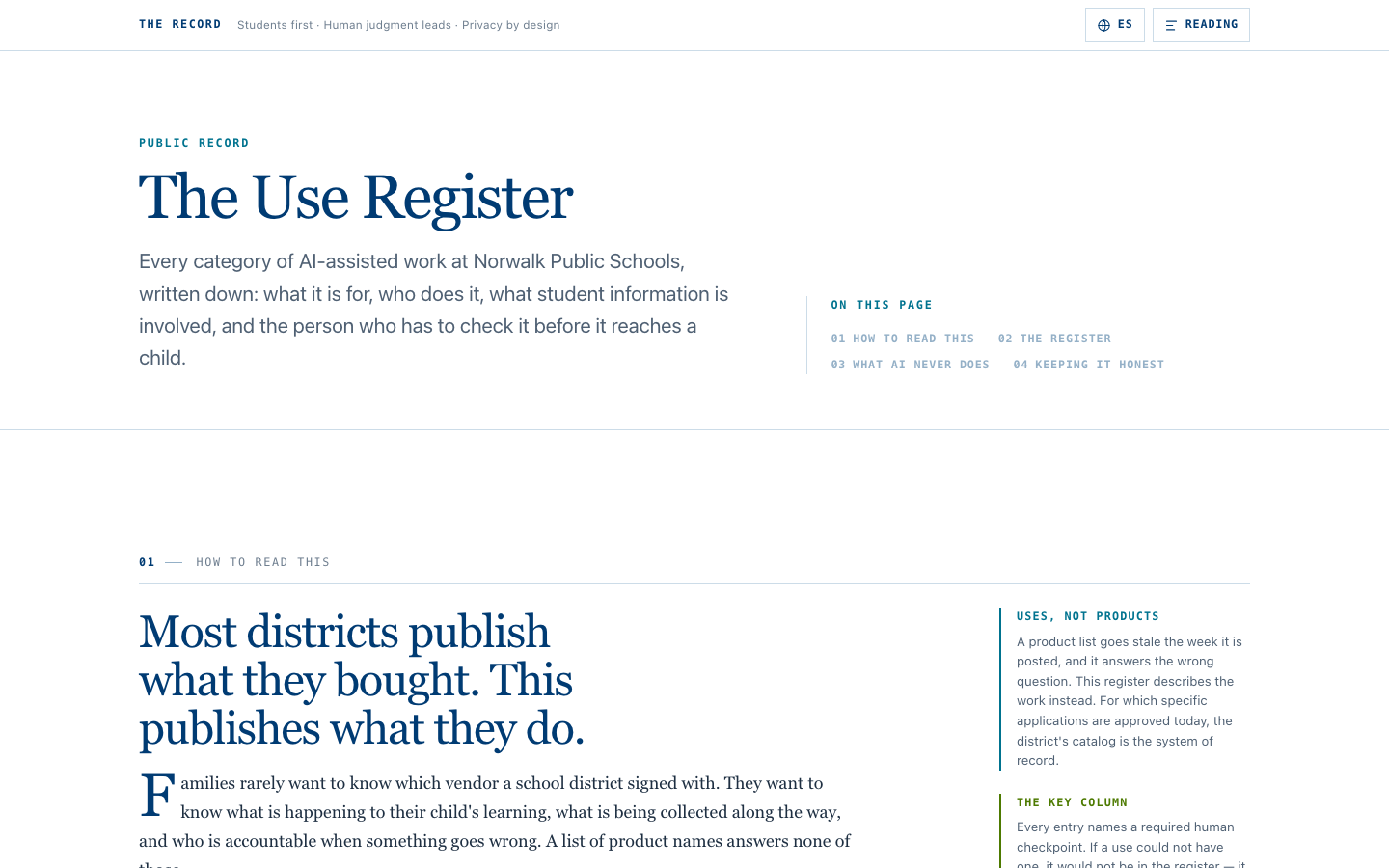
- 15 bilingual pages (English/Spanish) built from structured content and published into Google Sites
- AI Use Register: 8 categories of district AI use plus 7 decisions AI may never make. Each entry lists purpose, who performs it, what data is involved, the required human checkpoint, and what it may "never become."
- Classroom AI Use Scale (0–4) with copy-ready assignment wording in both languages
- SMART student framework: Seek permission, Make it your own, Acknowledge sources, Review for accuracy, Think critically
- Grade-band progression: K–2 no AI; 3–5 concepts only; 6–8 strict guardrails; 9–12 approved tools under SMART
- 37-term glossary with every term defined twice, once plain and once precise
- Answer Desk (31 entries), 12-scenario policy checker, family conversation kit (20 age × topic combos), and an AI toy safety guide
- A 5:22 narrated video overview with captions
The AI Guidebook
Alongside the site, I authored a 14-chapter, ~9,000-word K-12 AI Guidebook in collaboration with the Assistant Superintendent, aligned to FERPA, COPPA, PPRA, CIPA and Connecticut student-data-privacy law, with chapters on privacy, accuracy and bias, academic integrity, AI at home, administrative use, and incident response.
The AI design
The content itself is AI-literacy writing: explaining how models fail in language a parent can act on.
"These systems generate likely text, not verified fact. A fluent, confident paragraph with an invented source in it is the normal failure mode."
"Machine translation is a draft, not a publication."
I built the site with Codex planning and Claude Code implementing. Content lives in structured modules, so the policy is data rather than copy scattered across pages, and one change updates every page that uses it.
How I verified it
- 800+ automated build checks enforce accessibility basics (one h1, skip link, labels, alt text) and English/Spanish parity. The build fails if the two languages drift apart.
- Contradiction review: I wrote an alignment map cross-checking every guidebook claim against the site and colleague edits, and logged each conflict with its resolution.
- That review removed overclaims (predictive analytics described as current practice), removed an unsafe example (a social-emotional chatbot for young students), and narrowed promises about data use.
- I reframed tool approval: "approval attaches to an application and intended use, audience, grade level, account, feature, and data context", not to a brand name.
Impact
- Public to the whole Norwalk community
- Presented at a Google for Education conference in New York City
- Other districts now reach out to NPS for AI guidance based on the site
What this shows for AI training roles
- Writing precise, two-level explanations of how AI works and fails
- Designing scales and rubrics (0–4 use scale, scenario checker) that people can apply consistently
- Human-in-the-loop governance: every AI use has a named human checkpoint
- Catching unsupported claims in a draft before they reach the public